
Planning guide
Bathroom Renovation Cost in Jacksonville, FL
This guide explains what actually drives bathroom renovation cost, why two estimates for the same room can differ substantially, and where your money buys lasting value rather than just appearance.
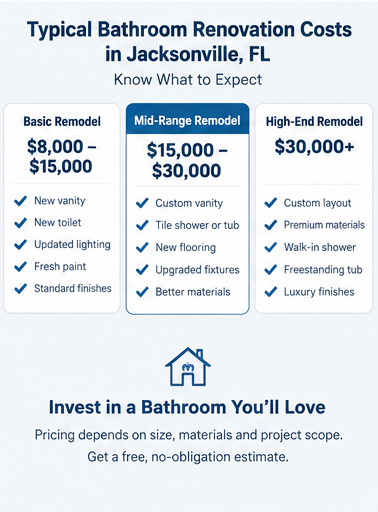
The cost categories in every bathroom project
Almost every dollar in a bathroom renovation falls into one of these buckets. Understanding the mix is what makes a budget conversation productive.
- Demolition and disposal
- Framing corrections and blocking
- Rough plumbing and fixture rough-in changes
- Electrical work, circuits, switching and lighting
- Waterproofing assembly in the wet area
- Tile material and setting labor
- Flooring material and installation
- Cabinetry and countertops
- Plumbing fixtures and trim
- Glass enclosure
- Ventilation and ductwork
- Paint, trim and hardware
- Project management and coordination
- Permits and inspections where applicable
- Contingency for existing conditions
Why estimates vary so much
The single biggest reason is scope definition. One estimate may assume the shower is rebuilt with a manufactured pan kit and standard tile to shower-head height, while another assumes a mortar-bed pan, curbless entry, large-format tile to the ceiling and custom frameless glass. Both are 'a shower.' They are not the same project.
The second reason is what is included. Does the number cover the vanity and countertop, or only labor? Does it cover the exhaust fan upgrade and duct rerouting? Does it include a contingency for what is behind the walls? Comparing estimates only works when the inclusions match.
The third reason is existing conditions. An identical design in a 1925 Riverside home and a 2019 Nocatee home involves different preparation, different discoveries and different amounts of correction before new material goes in.
How room size changes the math
Size drives material quantities — floor tile, wall tile, flooring, countertop — but not labor proportionally. Setup, protection, demolition, waterproofing, plumbing and trade coordination all happen regardless of square footage, which is why very small bathrooms rarely cost proportionally less.
Where size does matter greatly is tile coverage. A large primary bathroom with full-height tile on multiple walls can carry several times the tile area of a compact hall bath, and tile is material plus labor-intensive setting time.
Guest bath versus primary bath
| Guest / hall bath | Primary bath | |
|---|---|---|
| Typical footprint | Compact, single fixture wall arrangement | Larger, often with separate wet area |
| Shower expectations | Alcove shower or tub-shower combination | Large tiled shower, sometimes dual controls |
| Tub | Often retained for household and resale | Optional; freestanding tubs common |
| Vanity | Stock or semi-custom single | Semi-custom or custom, sometimes double |
| Tile coverage | Floor plus wet area | Floor, wet area, often feature walls |
| Relative budget position | Lower end of planning ranges | Upper end of planning ranges |
Shower, tub, tile and vanity costs
Showers are the most variable element. A rebuilt alcove shower with a manufactured pan and standard tile sits at the low end. Adding a curbless entry, a bench, multiple niches, large-format tile to the ceiling and custom frameless glass can multiply that.
Tubs split into three tiers: replacing an alcove tub is the most economical; a drop-in tub in a tiled deck is mid-range; a freestanding tub with a floor-mounted filler is the most expensive because of the tub, the valve and the rough-in work.
Tile cost is coverage multiplied by complexity. Two bathrooms using the same tile can differ significantly if one has a herringbone feature wall and full-height coverage. Vanity cost climbs from stock to semi-custom to custom, and the countertop is a separate decision — quartz, granite or solid surface.
Plumbing, electrical and waterproofing
Plumbing cost is driven by relocation, not by fixture count. Keeping the drains and valve in place keeps this line item modest. Moving a toilet or shower drain — especially in a slab-on-grade home where concrete must be cut and patched — is one of the largest single cost jumps available in a bathroom project.
Electrical work ranges from swapping a fixture to adding circuits, GFCI protection, dedicated lighting zones, dimmers and outlets inside cabinetry. New circuits and switch relocations involve opening walls and, where applicable, inspection.
Waterproofing is a modest share of the total and the least sensible place to economize. The assembly — sloped pan, membrane, treated seams and penetrations, correct drain connection — is what determines whether the tile work lasts.
Glass, demolition and material levels
Frameless glass is priced by glass area, thickness, hardware and the number of notches and cuts. A single fixed panel is far less than a hinged door with a return panel, and custom glass is measured after tile is complete, which places it late in the schedule.
Demolition cost follows extent and disposal. Removing only the tub surround differs greatly from taking a room to studs and subfloor, particularly when multiple layers of past flooring are involved.
Material level is a genuine lever. A value-conscious package uses well-made stock cabinetry, standard-format porcelain and solid mid-range fixtures. A premium package uses custom cabinetry, large-format or natural stone, designer fixtures and custom glass. The construction underneath can be identical.
Hidden conditions and contingency
Common discoveries include prior water damage at a shower corner, aging supply lines, undersized or damaged framing, non-vented exhaust ducts, out-of-level floors and previous work that was not done to current standards.
A sensible contingency — commonly around ten to fifteen percent of the project budget, and higher in older homes — turns a discovery into a decision instead of a crisis. It is the most useful line in any renovation budget.
Where to save and where to spend
| Decision | Cost-saving approach | Value-spending approach |
|---|---|---|
| Layout | Keep all fixtures in place | Move only the vanity plumbing |
| Shower entry | Standard tiled curb | Low threshold instead of full curbless |
| Wall tile | Standard format to shower-head height | Full-height tile in the wet area only |
| Glass | Fixed panel rather than hinged door | Quality hardware and treated glass |
| Cabinetry | Well-made stock or semi-custom | Drawer-based interiors over decorative fronts |
| Counters | Solid surface or entry-level quartz | Quartz for maintenance-free longevity |
| Never economize | — | Waterproofing, substrate prep, ventilation |
Refresh versus renovation
If the layout works, the wet area is sound and the complaint is aesthetic, a refresh — paint, mirror, lighting, faucet, toilet, hardware, possibly a vanity swap — delivers a large perceived change for a small fraction of a renovation budget.
A full renovation earns its cost when the wet area needs rebuilding anyway, when several elements are failing at once, or when the layout is genuinely working against the household. Matching the scope level to the actual problem is the first and best budget decision.
Build your own planning range
The cost calculator on this site takes your bathroom type, size, scope level, shower and tub plans, vanity, tile coverage, layout and material level and produces a low-to-high planning range, a list of the drivers behind it, and a relative complexity rating.
It is a planning tool, not a quote. A project-specific number requires measurements, an assessment of existing conditions and confirmed product selections.
Illustrative planning ranges only. Actual bathroom renovation pricing varies by room size, materials, layout changes, labor requirements, plumbing/electrical work and project scope.
Talk through your bathroom
Describe the room, what bothers you about it and what you would like it to become. Planning conversations are free and there is no obligation.
Call now for service availability. Please have your 5-digit ZIP code ready.
Frequently Asked Questions
Why won't a contractor quote a price over the phone?
Because the two things that most affect cost — existing conditions and confirmed scope — cannot be assessed by phone. A planning range is a reasonable conversation; a firm number requires measurements and selections.
What is the most expensive single decision in a bathroom renovation?
Usually relocating drains, particularly on a concrete slab. After that, custom cabinetry, large frameless glass assemblies and a curbless entry requiring structural slope work.
How much contingency should I hold?
Commonly ten to fifteen percent, and more in an older home. If nothing unexpected appears, it becomes an upgrade fund rather than a loss.
Do permits add much to the cost?
Requirements and fees vary by jurisdiction and scope, and they change over time, so we do not quote fee figures here. Confirm current requirements for your property with the appropriate Jacksonville, Duval County or local permitting authority.
Is it cheaper to renovate two bathrooms at once?
There are efficiencies in shared mobilization, protection and material orders. Whether it is right depends on whether your household can manage both rooms being out of service.
Keep planning
Ready to Plan Your Jacksonville Bathroom Renovation?
Share your bathroom size, goals and rough budget to discuss realistic options, materials and available next steps.
Service availability may depend on ZIP code, project scope, participating provider availability and scheduling.