
Planning guide
Bathroom Tile Guide
Tile decisions come in four layers: material, format, layout and grout. Getting all four right is what separates a bathroom that looks designed from one that looks assembled.
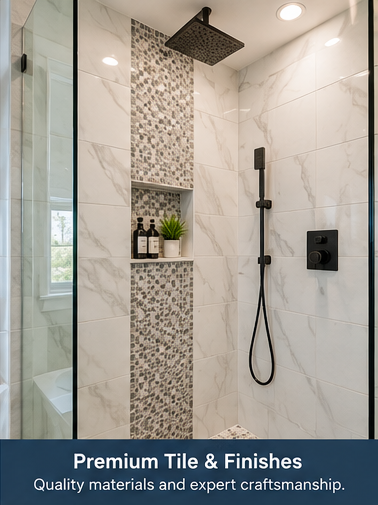
Porcelain, ceramic and stone
Porcelain is fired denser than ceramic, which makes it more water-resistant and more durable. It is the default for bathroom floors, shower floors and shower walls, and it now convincingly imitates marble, limestone, concrete and wood.
Ceramic remains a strong value option for walls and lower-traffic floors. It cuts easily, comes in an enormous range of glazes and shapes, and performs well where it is not taking heavy abuse.
Natural stone brings genuine depth and variation. It also requires stone-appropriate cleaning products, periodic sealing for many stones, and more care about acidic cleaners. In a busy family bathroom, that maintenance is worth considering honestly.
Formats and where they work
| Format | Best use | Notes |
|---|---|---|
| Large format (12x24 and up) | Shower walls, bathroom floors | Fewer grout lines; needs a very flat substrate |
| Subway / rectangular | Shower walls, wainscot | Classic and forgiving; many layout options |
| Square (4x4, 6x6) | Walls, period-appropriate designs | Suits older homes well |
| Mosaic / penny / hex | Shower floors, accent bands | Grout joints improve grip; more cleaning |
| Plank / wood-look | Bathroom floors | Warmth of wood with tile performance |
| Vertical stack | Feature walls | Requires precise layout to look right |
Layout decisions
Layout determines where cuts land. A good tile setter plans the starting line so that cuts fall in inconspicuous places, the niche centers sensibly, and the pattern does not end with a sliver at the most visible corner.
Pattern complexity drives labor. Running bond and stacked layouts are efficient; herringbone, basketweave and diagonal layouts involve more cuts, more waste and more setting time. Using a complex pattern in one feature area rather than everywhere is a reliable way to get the look without the whole-room cost.
Tile height in the shower is a design and protection decision. Running to the ceiling looks more finished, resists splash and steam better, and is common in Florida bathrooms.
Shower floors and slip resistance
- Small-format mosaic for grip through grout joints
- Textured large-format tile for a calmer look with traction
- Slip-resistance ratings checked for wet-area use
- Polished tile kept off shower and bathroom floors
- Slope maintained consistently to the drain
- Linear drains for single-plane slope in curbless designs
- Continuous floor tile from room into shower to enlarge the space visually
Grout, sealant and edges
Grout color changes the perceived pattern: matching grout makes tile read as a continuous field, contrasting grout emphasizes each piece. High-performance grout formulations resist staining better in showers than standard cementitious grout.
Changes of plane get flexible sealant instead of grout, because those joints move. Wall-to-floor, inside corners and tile-to-tub lines are caulked for that reason.
Edges deserve a decision too: bullnose tile, metal profile trim, a mitered edge, or a rounded finished edge. Left unplanned, this becomes the detail that makes an otherwise good tile job look unfinished.
Why installation matters more than material
Substrate flatness, correct mortar and trowel selection, full coverage behind the tile, proper movement joints and adequate cure times before grouting all determine whether tile stays sound. Premium tile installed poorly will fail; modest tile installed properly will not.
This is especially true of large-format tile, which shows lippage immediately when the substrate is not flat and requires more deliberate setting technique.
Talk through your bathroom
Describe the room, what bothers you about it and what you would like it to become. Planning conversations are free and there is no obligation.
Call now for service availability. Please have your 5-digit ZIP code ready.
Frequently Asked Questions
Can wood-look tile be used in a shower?
Often yes if the tile is rated for wet areas and floor use. The narrow plank format means more grout joints, which affects both look and cleaning.
What grout joint width should I use?
It follows the tile's edge profile, size and manufacturer guidance rather than personal preference alone. Rectified tile allows narrower joints; tile with variation needs a slightly wider joint to accommodate it.
Is marble a bad idea in a bathroom?
Not bad, but it is a commitment. Marble needs pH-neutral cleaners, benefits from sealing, and can etch from acidic products. Porcelain marble-looks avoid that maintenance entirely.
How much extra tile should be ordered?
Enough to cover cuts, waste and future repairs. Complex patterns and diagonal layouts need a higher allowance, and holding a small amount after the project means a future repair can match.
Keep planning
Ready to Plan Your Jacksonville Bathroom Renovation?
Share your bathroom size, goals and rough budget to discuss realistic options, materials and available next steps.
Service availability may depend on ZIP code, project scope, participating provider availability and scheduling.